Go to India
John Sydenham

India is one of my favourite places in the world. The heat, the noise, the colour, the dirt, the smells.. It is so different from Europe it is amazing.
I am in Tamil Nadu at the moment. Rapid development has placed a layer of concrete infrastructure on the land. Fairly good intercity roads join large factories on top of the same old countryside and towns. The economic boom in Southern India is unlike that in China. The towns are not full of high rise building sites. There is a lot of suburban housing development. A few cities such as Hyderabad and Bengaluru have modernised areas but most are much the same. Agriculture in some areas, such as parts of the Deccan, has been taken over by corporate farming interests so that there are large fields farmed by machinery.
I am nostalgic for elephants ambling down the road as they did a few decades ago but everything changes.
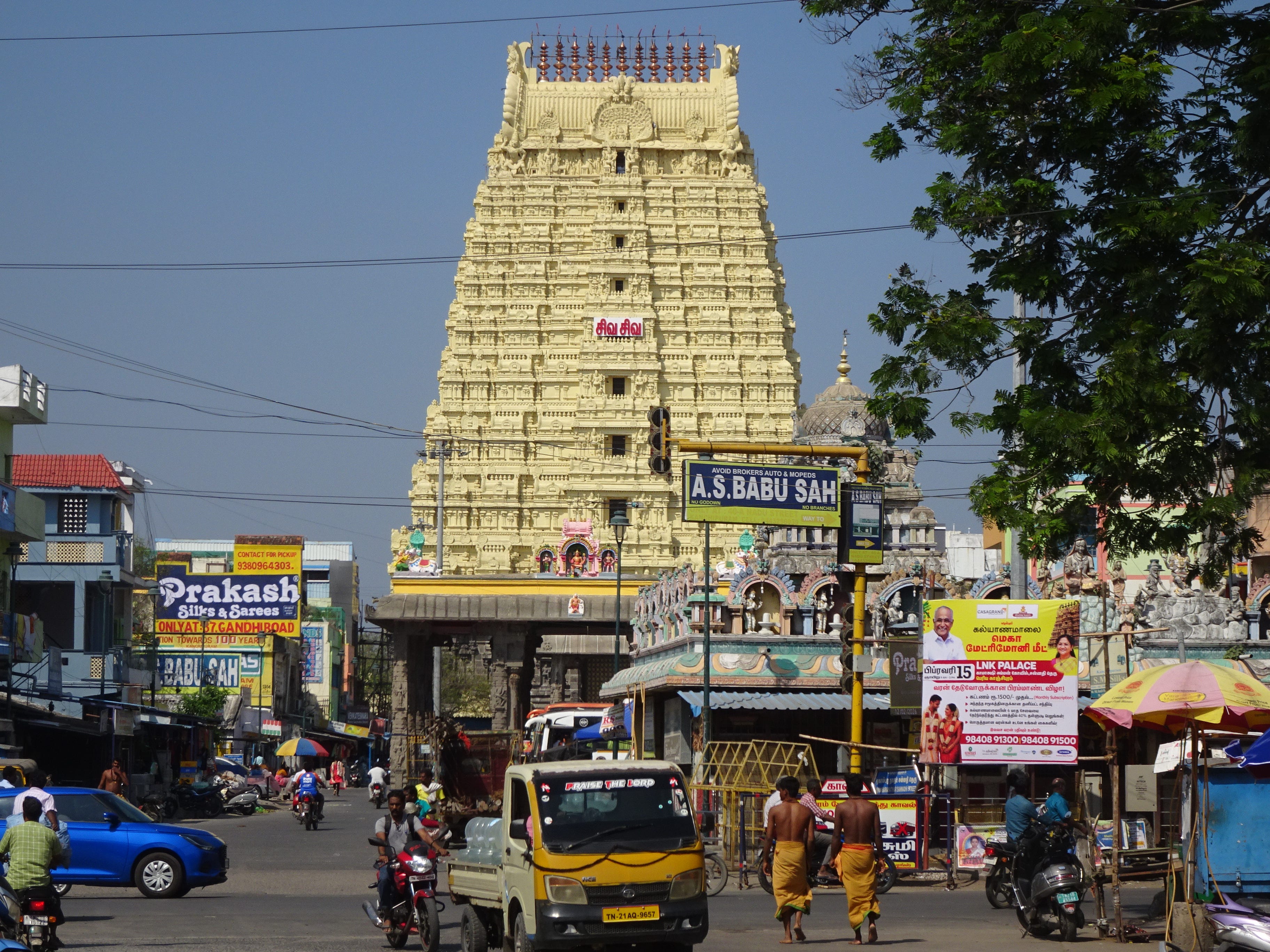
(But as you can see above, India is still very interesting).
Caste, sub-caste (Jati) and family dominate the lives of Hindus. Making a good marriage within caste boundaries is of fundamental importance. This approach to life has been planted firmly in the UK Hindu population which takes the view that you can marry anyone you want so long as you make ‘sure to fall in love with someone of the same religion, ethnicity and class’ (See The Conversation). Hindu businesses employ family first, jati next.
It is probably fair to say that Hinduism is about social hierarchy rather than religion. I had an excellent conversation with a young medical student who seemed to know little about the philosophy of Hinduism but was fully occupied with family.
No Indian Hindu likes to say to a European that when they see a beggar they shrug and think “see what happens if you failed in a previous life” or, having given alms think “this good deed will save me from being afflicted like that in the next life”. In 1999 Glen Hoddle was sacked from the post of England football manager for voicing such beliefs. Had he been born in India those sacking him would have been sacked.
You might wonder why I love India but despite this I can write the paragraphs above. What I have written above is just the truth. Nations can have all sorts of beliefs. I am happy for Indians to have those beliefs in India, it creates an interesting society with its own balance and virtues.
In the UK we have about 30% of the population who would happily allow Hindus, Moslems and any other way of life to dominate UK society. These people are the Internationalists. Internationalists should go to India. They would find lovely, likeable people who are culturally very different from the native English. “Vive la différence”, but only an ignorant or malevolent person would wish to risk the effects of millions of people with such a different culture on England. Sadly our public sector (education etc.) is full of ignorant and malevolent people. The Internationalists are more of a danger to England than Hindus, they would snuff out the rest of the English completely (see The Destruction of Britain). Internationalists can see nothing good about the English, they should get out more, go to places like India and reflect on whether they really want to replace us, whether their grandchildren are really going to be happy as a minority in the country the Internationalists are creating.
More Details
Hinduism has proven surprisingly flexible. What is superficially a primitive polytheistic religion has been adapted to several philosophical viewpoints. Some Indian philosophers have argued that the gods are aspects of one God (monotheism) and would point to the Holy Trinity in Christianity as a similar belief. Others would characterise the self-realisation of ‘Moksha’ as akin to Buddhist nirvana. However, I am not sure how far most ordinary Hindus would distance themselves from straightforward idolatry (there are some beautifully sculptured idols). The melange of interpretations has attracted a few Western ‘lost souls’ to participate - good luck to them.
(The spiritual side of Hinduism is interesting but Hinduism is really about family, jati, caste, ethnicity. Anyone who thinks their grandchildren would have a role in a South Asian dominated UK should think again.)
Indian history has several phases. The Aryans seem to have invaded in about 1500BC and brought the basic Hindu polytheism of the Vedas with them, the Indian Mauryan Empire conquered much of India between 320BC and 185BC and favoured Buddhism, a Hindu revival occurred from about the 7th century AD onwards. Islam then swept into India from the end of the 12th century although Hinduism survived in the South and in the countryside. The European Empires gained footholds in India from the16th century with the British East India Company becoming triumphant in the18th century.
The East India Company acquired an army to fight the French during the 18th century Anglo-French wars. It then leased out troops to Indian princes in return for trading rights and ever increasing control. The East India Company army employed large numbers of native troops (sepoys) which it trained in European methods of warfare.
The introduction of the telegraph in the mid nineteenth century meant that the East India Company came unstuck as immediate reports of its operations reached the London newspapers. The worst mess happened when some of the sepoys mutinied against the Company in 1857. The Company no longer had the luxury of a few months delay before news got back to Britain, it could no longer report that everything was calm and under control whatever had really happened. The British government was forced by media and Parliamentary pressure to intervene and the official British rule of India, called the Raj, began. Even at the height of the Raj about 40% of India was ruled by semi-autonomous “Princely States” (in yellow below):
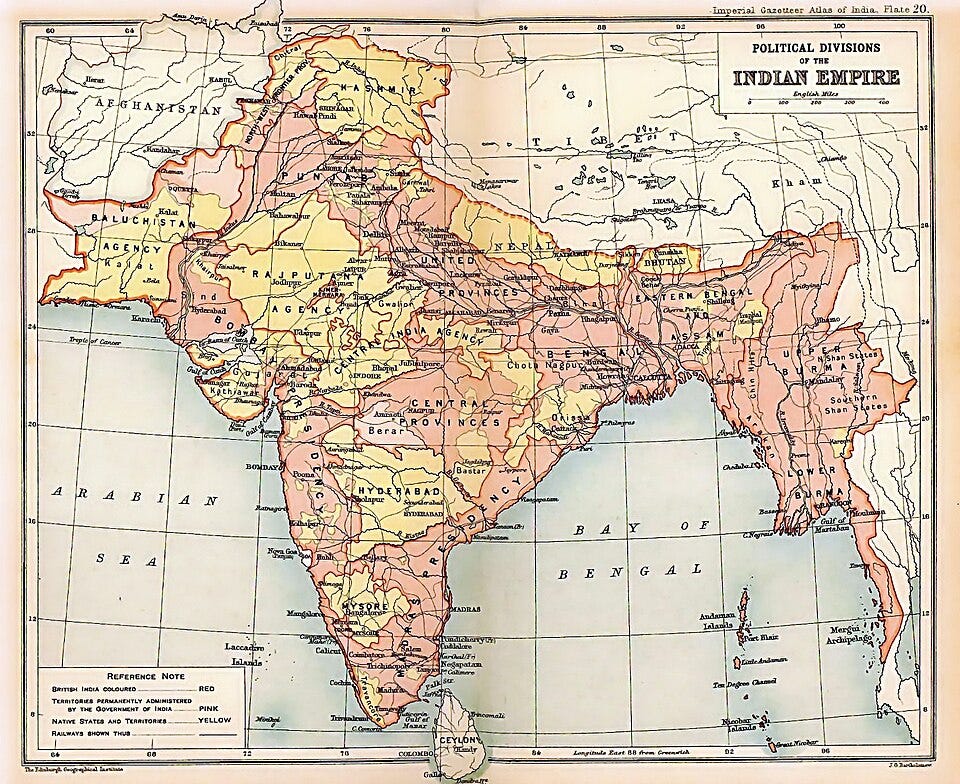
The great achievement of the Raj was to unite India into a single country with a customs union and common approach to law from Madras to Delhi. The Raj also brought peace and security to the previously warring states.
When you see the wealth, forts and palaces of the Princely States it is clear that there was an element of symbiosis between the Indian elite and the British. The educated Indian governing class realised that they had to enter the modern world to survive. Being client states suited their purpose admirably. They didn’t see Gandhi coming until it was too late. But the whole world changed after WWII as power realigned to US hegemony vs communism and the British and French renounced their empires.
I went round the “Gandhi Museum” today. Gandhi was highly anglicised and his great achievement was to realise that independence was coming anyway. He prevented unnecessary bloodshed. The Gandhi Museum didn’t see things that way. It described the mutiny of the sepoy mercenaries against the East India Company as “The First War of Independence”. It failed to mention that a Company army of Sikhs put down the mutineers at Lucknow. It didn’t note that the bloodthirsty General Dyer was given a medal by the local Council in Amritsar for putting down the riots by outside agitators. And so on..
However, whatever the shortcomings of the Gandhi Museum, it did demonstrate that if you want to forge a united nation you have to create a common culture. The BJP have been using Hinduism for that purpose and have been quite successful.
I was in Patiala in 1997. At the Gmykana Club there a Sikh informed me (over a beer) that there was something of "Old England" in him even though he had never been outside the Punjab. The ease of conversation with implicit shared cultural references and understanding led me to think there was indeed soemthing of England in him. At the rate things are going here Old England may soon only exist in her former peoples overseas.
India is amazingly cheap and safe, though a little weird.
It's a great place to get dental work done (at a fourth the cost of US dentists, by Western trained dentists). Hotel rooms were $10 to $20 a night. Cell phones were ubiquitous, with monthly service charges only $7. Just make sure you ask the price first before hopping into the nearest auto-rickshaw.
I never felt threatened there, but what animosity i did receive seemed to be coming mainly from Muslims, with a few yelling and cursing me out in Urdu, because i wouldn't give or buy their junk.
The beggars were on a whole 'nother level, though: children, amputees, a guy with half his face and body burnt up by fire. Every anomaly under the sun. Cold hearted bastard that i am, i never gave.
Anyway, have fun. Hope to get back there myself...